
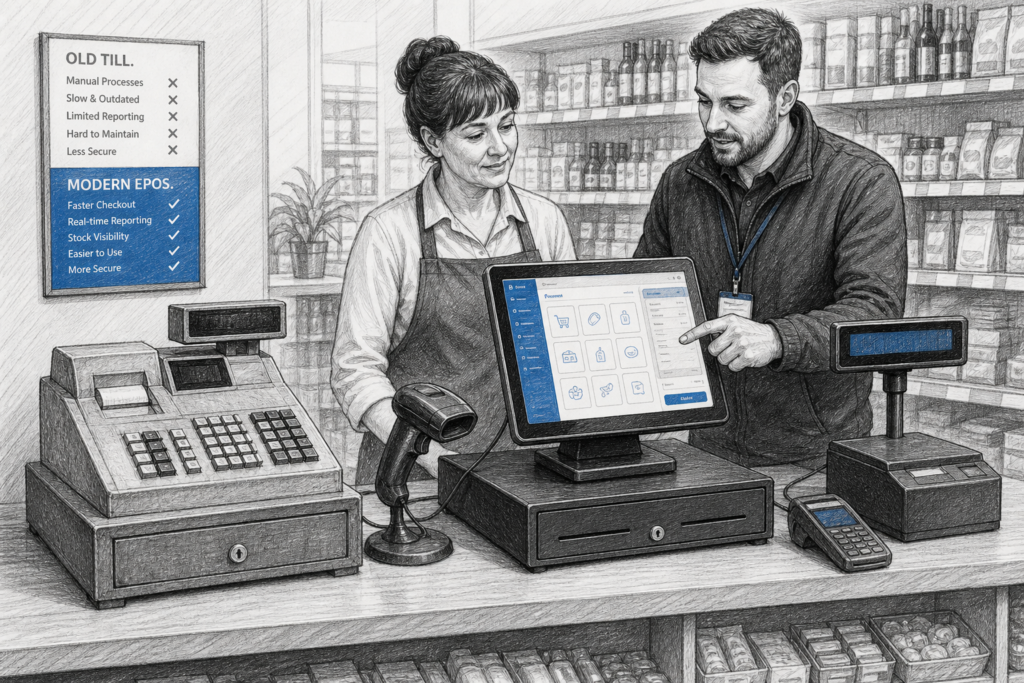
Across UK retail, the basic till is being replaced by modern EPOS systems for a simple reason: businesses need more from the checkout than taking payments and printing receipts. Whether it is a convenience store, garden centre, gift shop or multi-site retailer, the point of sale now plays a central role in speed of service, sales reporting and day-to-day control.
For many owners and installers, the upgrade is not about changing technology for its own sake. It is about replacing ageing hardware that slows staff down, creates avoidable downtime and makes it harder to manage the business properly.
What is driving the move away from basic tills?
Traditional tills were designed for straightforward transactions. They still have a place in some businesses, but they often fall short when retailers need barcode scanning, product look-up, staff permissions, promotions or detailed reporting. Modern POS systems UK retailers are adopting usually combine touchscreen operation, integrated peripherals and software that can support more than just the sale itself.
That matters because retail expectations have changed. Customers want quicker queues, accurate pricing and a smoother checkout experience. Staff need clear screens and easy navigation. Managers want to see what has sold, when it sold and which products are moving best. A basic till can struggle to support those requirements without extra steps or manual work.
The practical advantages of modern EPOS hardware
When people talk about EPOS hardware, the focus often falls on features. In practice, the benefits are about what those features do in a real shop.
- Touchscreen operation can make training simpler and reduce mistakes at busy tills.
- Integrated barcode scanning helps speed up checkout and reduce keying errors.
- Sales reporting makes it easier to spot patterns, manage stock and plan staffing.
- Customer-facing displays help reassure customers that prices are correct.
- Better peripheral support allows retailers to build a system that suits the way they trade.
For a busy convenience store, these improvements can shave time off each transaction and reduce pressure during weekday rushes. In a garden centre or gift shop, useful item search and clear category layouts can help staff serve customers without needing to memorise every product. For a retailer with more than one branch, centralized reporting can make it easier to compare performance across sites.
Why reliability matters more than ever
One of the biggest reasons businesses replace ageing tills is downtime. Older equipment often becomes less reliable over time, especially where it is used for long trading hours. Buttons wear out, displays become harder to read and support for older systems can become more difficult to manage.
Commercial-grade POS hardware is built with busy trading conditions in mind. That does not mean every system needs to be complex. It means choosing equipment that is suitable for daily use, easy to support and able to fit into a retail environment without constant attention. For installers and resellers, that also means thinking beyond the hardware itself and considering cable management, backup planning and how each component will be supported once it is live.
Windows POS versus Android POS in retail
A common decision in the UK point-of-sale industry is whether to deploy Windows POS or Android POS. Both can be suitable, but they tend to fit different priorities.
Windows POS is often chosen where a business wants familiarity, compatibility with established software environments or a more traditional setup. Android POS is often attractive where simplicity, mobility and a cleaner touchscreen interface are important. For some retailers, the choice is influenced by the software they already use. For others, it is about the kind of day-to-day experience they want for staff.
The right answer depends on the business, not the trend. A high-street retailer with a fixed checkout may prioritise stability and robust hardware. A business with changing store layouts, pop-up sales or multiple service points may value flexibility and portability more highly.
Planning an EPOS upgrade without disrupting trade
Replacing a till is not just a hardware purchase. It is an operational change. That means planning matters.
Before upgrading, retailers should consider:
- how many checkout points are really needed
- what peripherals must connect to the system
- how staff will be trained on the new setup
- whether the existing software environment will remain in place
- how to reduce downtime during installation
Installers and EPOS dealers are often best placed to help with this part of the process. The goal is to make sure the hardware suits the workflow rather than forcing the store to adapt around the system.
Why UK support makes a difference
For retailers and resellers alike, UK-based product knowledge and support can save time when a project needs to move quickly. Sourcing the right POS hardware UK businesses can rely on is easier when the distributor understands local retail requirements, installation realities and the pressure of keeping trade moving.
YCR Distribution works with EPOS dealers, resellers, installers and business owners across the UK, supplying point-of-sale hardware and related technology through a distributor model built around practical support. If a retailer is replacing an ageing till, or a reseller is planning a new installation, having access to a knowledgeable EPOS distributor UK teams can turn to is often as important as the hardware itself.
Choosing the right time to upgrade
There is no single point when every business should replace a till, but there are clear signs that an upgrade is overdue. These include frequent breakdowns, slow service at peak times, limited reporting, poor usability for staff and difficulty finding compatible replacement parts. When those issues start affecting trading, modern EPOS systems often offer a better long-term option.
The best upgrades are usually the ones that solve a real business problem. That might be improving checkout speed, reducing admin or giving managers more visibility over sales. In many cases, modern POS systems UK retailers choose are less about adding complexity and more about making everyday tasks easier to manage.
For more information about point-of-sale hardware and EPOS solutions, contact YCR Distribution on 01924 438238 or visit www.ycr.co.uk.