
What is unattended POS? A guide for retail and hospitality
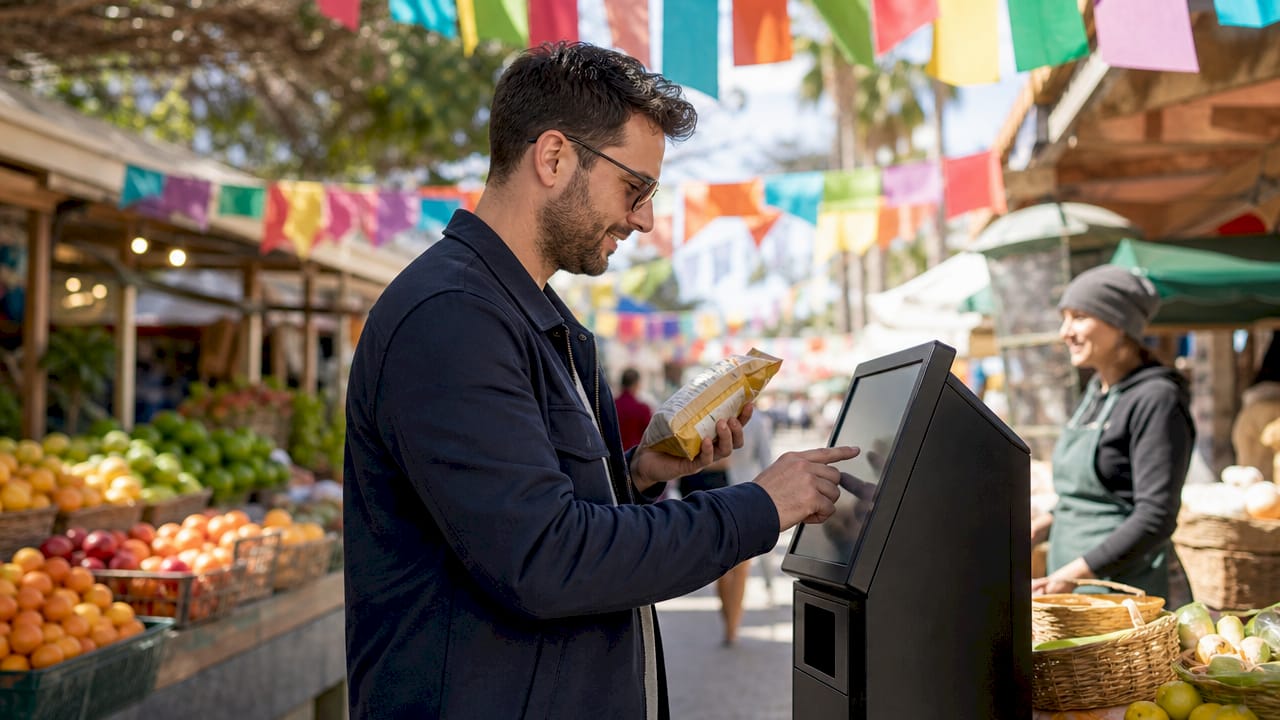
Unattended POS is defined as a self-service payment terminal that processes transactions without a cashier or operator present. The industry term for this category is “unattended point of sale,” and it covers everything from supermarket self-checkouts and vending machines to parking kiosks and petrol pumps. The global unattended terminal market is projected to grow from $1.58 billion in 2024 to $1.76 billion in 2025, driven by demand for 24/7 availability and lower labour costs. That growth reflects a clear shift in how retail and hospitality operators think about service delivery, speed, and staffing.
What is unattended POS and how is it defined?
An unattended POS system is a self-service hardware device that handles secure customer transactions with no cashier present, used across retail, hospitality, transport, parking, and energy sectors. Common examples include ticket kiosks, vending machines, petrol pumps, parking meters, and supermarket self-checkouts. The defining characteristic is full autonomy: the terminal guides the customer through every step of the transaction without any staff involvement.
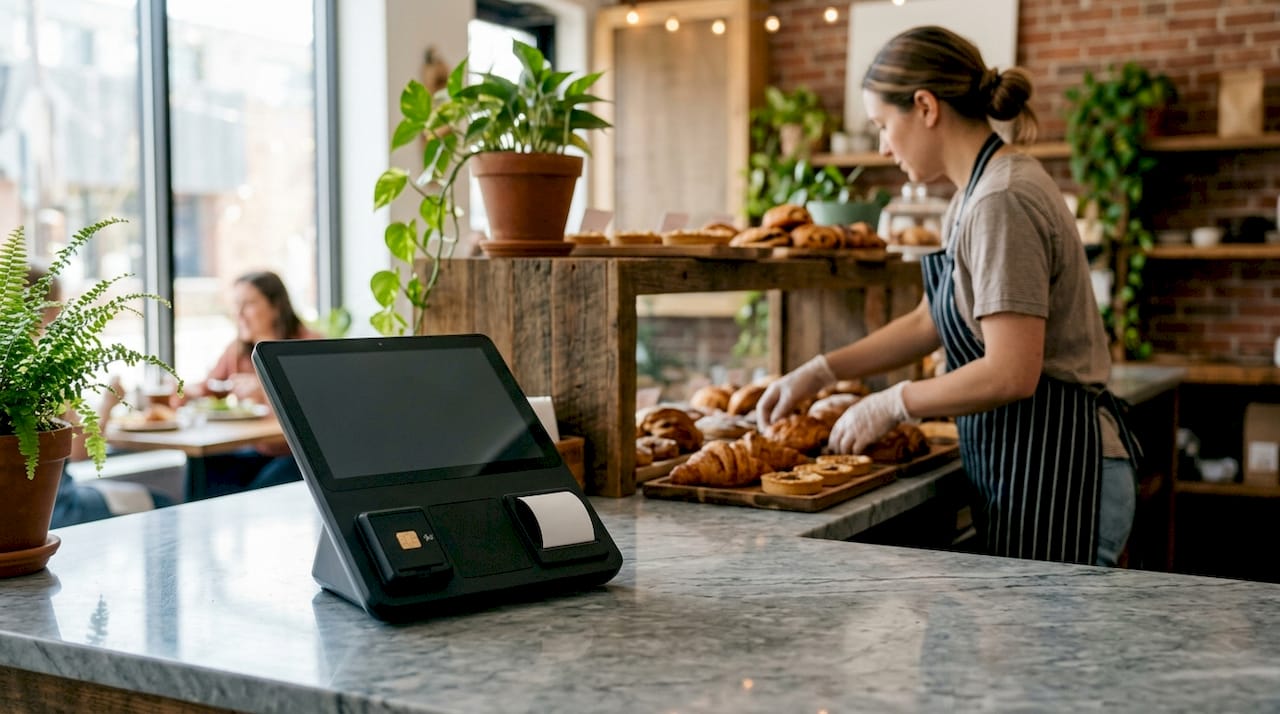
This matters for business owners because it changes the fundamental equation between labour, capacity, and operating hours. A single member of staff can oversee several unattended terminals rather than serving one customer at a time. That shift in model is why sectors with high transaction volumes and predictable purchase flows have adopted unattended payment solutions at pace.
The term “unattended retail technology” is sometimes used interchangeably, but the precise industry classification is “unattended POS environment,” which carries specific technical and certification requirements distinct from attended or semi-attended setups.
How does unattended POS work?
Unattended POS terminals handle the entire payment process independently, from payment method selection through to approval. Understanding the transaction flow helps operators assess what infrastructure they need before deploying.
Here is how a typical transaction progresses:
- Customer selects a product or service. The terminal presents a touchscreen interface or physical button set. The customer makes their choice without staff guidance.
- Payment method is presented. The terminal accepts EMV chip, contactless cards, digital wallets, and QR codes, covering the full range of modern payment preferences.
- Encryption is applied. The terminal encrypts card data at the point of capture, before it travels anywhere. This protects sensitive information from interception.
- The payment gateway routes the request. The encrypted data passes through a payment gateway to the card scheme and issuing bank for authorisation.
- Approval or decline is returned. The issuer responds in seconds. The terminal displays the result and, where relevant, triggers a receipt or product release.
- Backend systems update. Many unattended terminals integrate with inventory, loyalty, and CRM systems via APIs, so stock levels and customer records update in real time.
Security configuration is tighter in unattended environments than in staffed ones. Stricter risk parameters apply, including lower contactless transaction floor limits, online-only authorisations, and no support for signature-based cardholder verification. These rules exist because there is no staff member to spot suspicious behaviour or intervene.
Pro Tip: When specifying an unattended terminal, confirm with your payment processor that the device is configured for unattended-specific CVM (Cardholder Verification Method) rules. A terminal set up for attended use will not apply the correct risk controls when deployed without staff.
How does unattended POS differ from attended systems?
The core operational difference between unattended and attended POS is the absence of staff, and that single factor affects costs, customer experience, security design, and the environments each suits best.
Attended POS places a trained operator between the customer and the terminal. That operator can upsell, handle exceptions, verify age, and resolve errors on the spot. Hospitality environments, where personal service and order customisation matter, tend to favour attended setups for this reason. A restaurant table service model or a barista-led coffee counter benefits from human interaction in ways a vending machine does not.
Unattended POS suits high-traffic, low-touch scenarios where speed and 24/7 availability outweigh the value of personal service. Supermarket self-checkout lanes, cinema ticket kiosks, and car park payment machines are all environments where customers know what they want and prefer to complete the transaction quickly.
The cost profile differs significantly. Attended POS carries ongoing labour costs but lower per-unit hardware investment. Unattended POS requires more durable, certified hardware and a remote monitoring infrastructure, but reduces the staffing requirement per transaction point. For high-volume retail, that trade-off typically favours unattended over time.
From a fraud risk perspective, attended terminals benefit from staff oversight as a natural control. Unattended terminals compensate through tighter technical controls, including mandatory online authorisation and stricter transaction limits, as detailed in the security section below.
| Factor | Attended POS | Unattended POS |
|---|---|---|
| Staff requirement | Required at terminal | Not required |
| Best environment | Hospitality, personal service | High-volume retail, transport, parking |
| Operating hours | Limited to staff availability | 24/7 capable |
| Fraud controls | Staff oversight plus technical | Technical controls only, stricter limits |
| Hardware cost | Lower per unit | Higher, durability-rated |
| Labour cost | Ongoing | Minimal per terminal |
What are the benefits and challenges of unattended POS?
Benefits for retail and hospitality operators
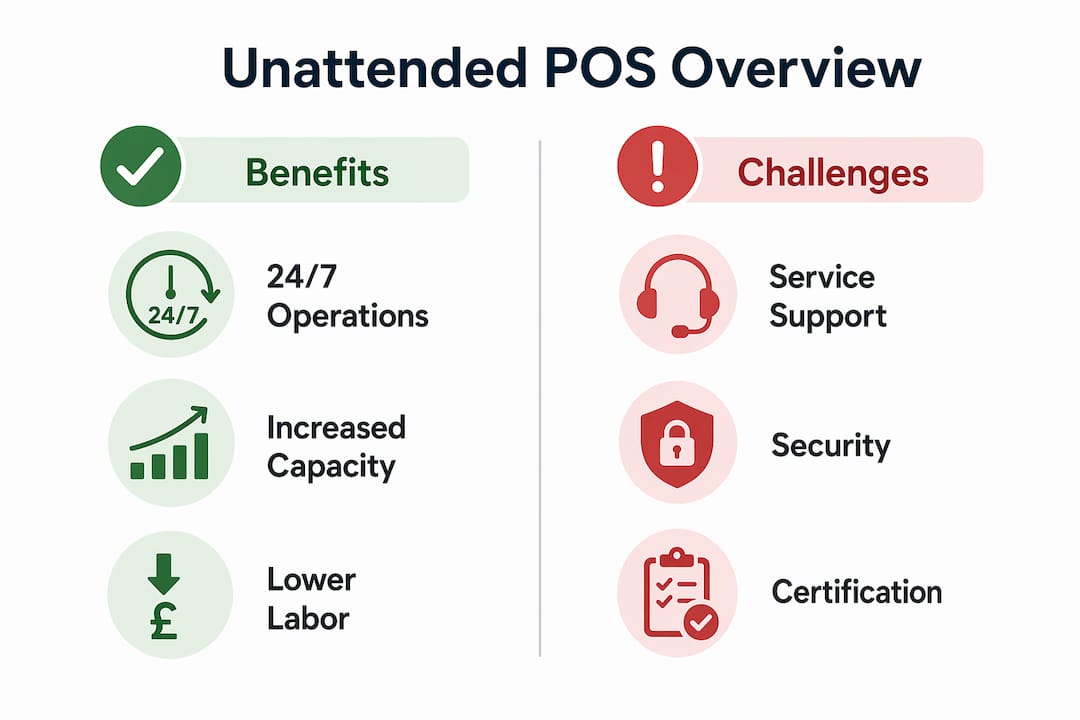
Unattended POS systems extend operating hours to 24/7 and increase transaction capacity without a proportional increase in headcount. That combination directly reduces labour costs per transaction, which is the primary financial driver for adoption. Operators also report faster average checkout times, because customers move at their own pace without waiting for a cashier to become available.
The capacity benefit is significant in peak trading periods. A retailer with four self-checkout terminals can process four transactions simultaneously with one staff member overseeing the area. The same floor space with four attended tills requires four members of staff.
For self-service POS deployments in convenience retail and quick-service food, the reduction in queue length during peak hours directly improves customer satisfaction scores.
Challenges operators must plan for
- Hardware durability. Outdoor and public-facing terminals must meet IP65 and IK10 ratings for ingress protection and impact resistance. A terminal rated for indoor retail will fail quickly in a car park or on a petrol forecourt.
- Level 3 certification. Unattended terminals require Level 3 certification, the most demanding POS certification standard, proving the device can handle all transaction scenarios, including errors, declines, and communication failures, without any operator intervention.
- Remote monitoring. Without staff on site, faults go undetected unless you have active monitoring in place. A terminal that goes offline at 11PM on a Friday can lose revenue all weekend.
- Software reliability. The interface must guide customers clearly through every step. Confusing UX causes abandoned transactions and frustrated customers with no one to ask for help.
- Maintenance response. Field support contracts become critical. Downtime at an unattended terminal is pure lost revenue.
Pro Tip: Build a service level agreement with your hardware supplier before deployment, not after. Agree a maximum response time for on-site faults and confirm whether remote diagnostics are included. Ycr offers next-day delivery on replacement hardware, which can significantly reduce downtime exposure.
Key factors for choosing and deploying unattended POS systems
Selecting the right unattended POS setup requires matching hardware, software, and support infrastructure to the specific environment and transaction type.
Certification and compliance
Every unattended terminal must carry Level 3 certification from the relevant card schemes. This is non-negotiable. A terminal without it cannot legally or technically process unattended payments under scheme rules. Verify certification status before purchasing any device.
Hardware specification by environment
Indoor retail environments can use standard commercial-grade terminals. Outdoor deployments, such as car parks, EV charging points, or external kiosks, require terminals with IP65 ingress protection and IK10 impact resistance as a minimum. Specifying below these ratings in a public outdoor setting leads to premature hardware failure and voids most warranties.
Integration with existing systems
Unattended POS terminals depend on deep backend integration with inventory, loyalty, and CRM systems via APIs to maintain accurate data and avoid revenue loss. If your existing POS infrastructure does not support API connectivity, factor integration development into the project cost and timeline.
Remote monitoring and field support
Proactive remote monitoring is the single most important operational factor after deployment. Operators who treat unattended POS as “set and forget” consistently underestimate downtime costs. A monitoring dashboard that alerts you to terminal faults, connectivity drops, or transaction failures in real time is not optional; it is the infrastructure that makes unattended POS viable.
Payment configuration
Work with your payment processor to configure transaction limits, accepted payment methods, and CVM rules specifically for unattended use. A configuration built for attended terminals will expose you to unnecessary fraud risk and may breach scheme compliance requirements. Reviewing your POS data security setup before go-live is a practical step that many operators skip.
| Deployment factor | What to specify |
|---|---|
| Certification | Level 3 (unattended scheme certification) |
| Outdoor hardware | IP65 ingress protection, IK10 impact rating |
| Backend connectivity | API integration with inventory, loyalty, CRM |
| Monitoring | Real-time remote dashboard with fault alerting |
| Payment config | Unattended CVM rules, online-only authorisation |
| Staff training | Remote diagnostics, basic fault escalation process |
Key takeaways
Unattended POS systems reduce labour costs and extend operating hours, but they require Level 3 certification, environment-rated hardware, and active remote monitoring to operate reliably and securely.
| Point | Details |
|---|---|
| Definition | An unattended POS processes transactions without a cashier, used in retail, hospitality, and transport. |
| Security design | Stricter CVM rules and online-only authorisation replace the fraud controls that staff provide. |
| Hardware ratings | Outdoor terminals need IP65 and IK10 ratings; indoor-rated devices will fail in public environments. |
| Level 3 certification | All unattended terminals must carry Level 3 certification to meet card scheme requirements. |
| Remote monitoring | Proactive monitoring is the critical operational factor; downtime without it means direct revenue loss. |
Why unattended POS is worth taking seriously in 2026
I have spent years watching retail and hospitality operators make the same mistake with unattended POS: they focus entirely on the hardware purchase and treat everything else as an afterthought. The terminal arrives, gets installed, and then six months later someone realises there is no monitoring in place, the payment configuration was copied from an attended setup, and the integration with the stock system was never completed properly.
The technology itself is not complicated. What is complicated is the operational discipline required to run it well. A self-checkout that goes down at 9AM on a Saturday and is not noticed until a customer complains at noon has cost you three hours of peak revenue. That is not a hardware problem. It is a process problem.
What I find genuinely interesting about the unattended POS market right now is how quickly customer expectations have shifted. Shoppers who would have found a self-checkout confusing five years ago now actively prefer them for speed. That behavioural change makes the investment case stronger than it has ever been, but it also raises the bar on interface quality. A clunky, slow, or confusing terminal is no longer tolerated.
My practical advice: treat your first unattended deployment as a pilot. Pick one high-traffic location, instrument it properly with monitoring and reporting, and measure transaction completion rates alongside revenue per terminal hour. The data from that pilot will tell you more about whether to scale than any vendor presentation will.
— John
Ycr’s POS hardware and software for unattended environments
Ycr has supplied POS hardware and software to UK retail and hospitality operators for over three decades, with a product range that covers both attended and unattended deployments.

For operators building or upgrading a self-service setup, the SAMTOUCH POS software with hardware package combines certified terminal hardware with software designed for retail and hospitality environments. Ycr also stocks a full range of POS hardware types suited to different deployment conditions, from indoor retail counters to more demanding public-facing installations. Same-day dispatch and next-day delivery mean replacement units reach you quickly when uptime matters most.
FAQ
What is unattended POS in simple terms?
An unattended POS is a self-service payment terminal that processes transactions without a cashier or operator present. Common examples include supermarket self-checkouts, vending machines, parking kiosks, and petrol pumps.
Is unattended POS secure?
Unattended POS systems apply stricter security controls than attended terminals, including online-only authorisation, lower contactless transaction limits, and no signature-based verification. These technical controls replace the fraud oversight that staff would otherwise provide.
What certification does an unattended POS terminal need?
Unattended terminals require Level 3 certification, the most demanding POS certification standard, which proves the device can handle all transaction scenarios autonomously, including errors and declines, with no operator intervention.
What hardware ratings do outdoor unattended terminals need?
Outdoor unattended terminals should meet IP65 ingress protection and IK10 impact resistance ratings as a minimum to withstand weather and vandalism in public environments.
How does unattended POS differ from a standard POS system?
A standard attended POS requires a staff member to assist the customer and manage the transaction. An unattended POS guides the customer through the entire process independently, with tighter technical security controls and no human fallback.