

Why choose enterprise POS solutions for multi-store retail

Enterprise POS solutions are the operational backbone of any serious multi-store retail business. They provide real-time, network-wide visibility of inventory and customer data across every channel, centralised control over pricing and promotions, and the kind of omnichannel fulfilment capability that customers now expect as standard. If you are running more than a handful of locations and still relying on disconnected systems or store-level POS terminals, you are managing reactively rather than proactively.
Here is the short version of why enterprise point of sale systems matter at scale:
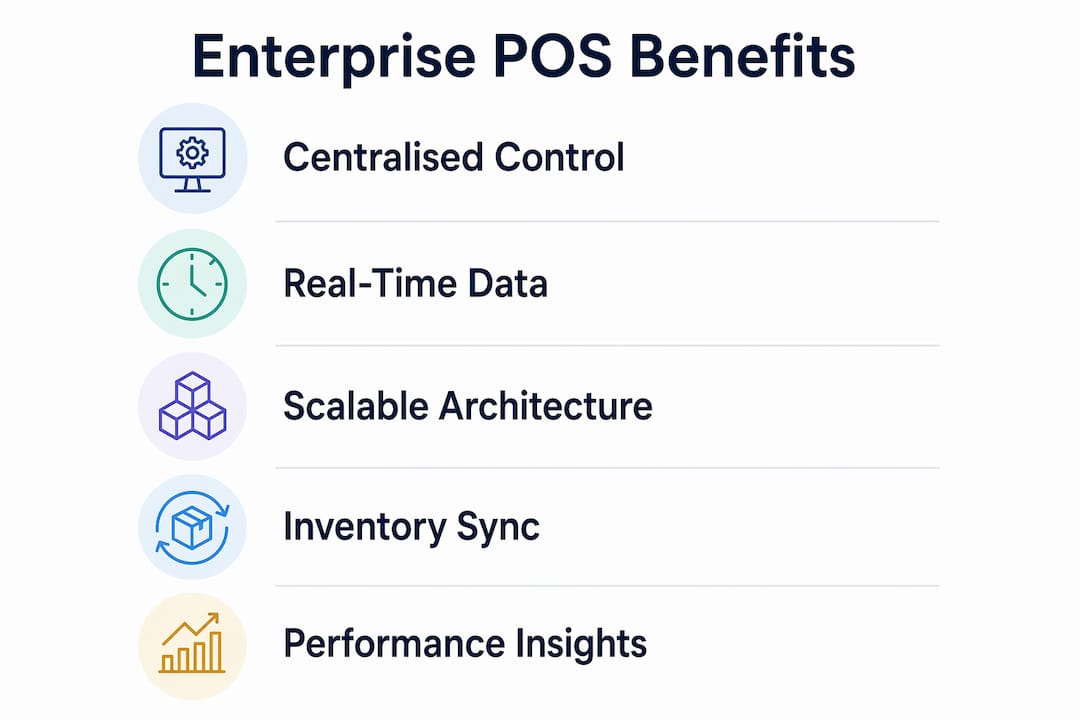
- Network-wide visibility: See stock levels, sales performance, and customer activity across every location in real time.
- Centralised control: Push pricing changes, promotions, and configuration updates to all stores from one console.
- Omnichannel fulfilment: Support buy online, pickup in-store, ship-from-store, and curbside collection without manual workarounds.
- 360-degree customer profiles: Track every customer interaction across channels to personalise service and drive loyalty.
- Scalable architecture: Add new locations without replacing the underlying system or accumulating technical debt.
- Consolidated reporting: Replace end-of-day summaries with live financial data that executives can act on immediately.
- Improved staff experience: Modern, intuitive interfaces cut training time and reduce the frustration that drives employee turnover.
What is an enterprise POS system?
An enterprise point of sale system is a centralised platform designed to manage sales transactions, inventory, staff, and customer data across multiple locations simultaneously. Unlike a standard POS terminal built for a single shop, an enterprise system treats your entire retail network as one unified operation. Every store feeds into the same data environment, and every configuration change flows outward from a single administrative console.
The distinction matters more than it might appear. A basic POS system scaled up with bolt-on multi-location features will always show the seams. Purpose-built enterprise platforms, by contrast, are architected from the ground up for the conditions that multi-location retail actually creates: concurrent transactions across dozens of sites, complex stock movements between locations, and the need for consistent pricing and brand experience regardless of where a customer shops.
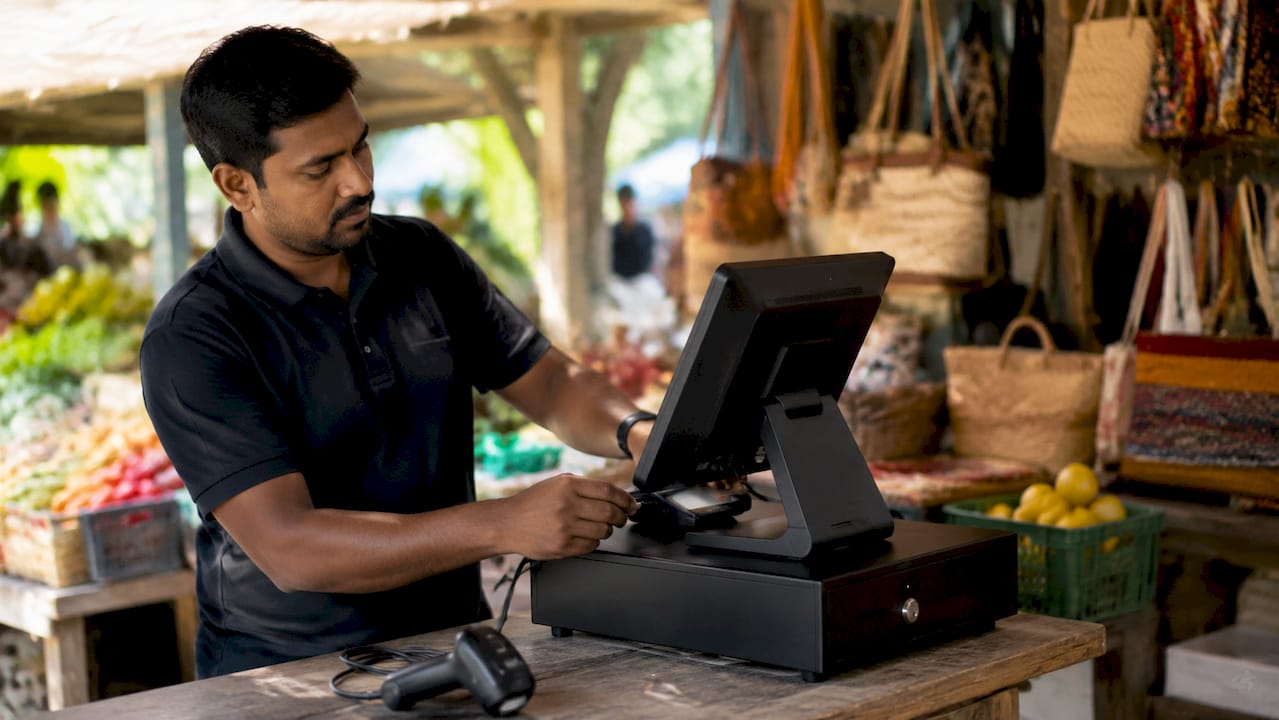
At the largest end of the market, enterprise POS systems also serve as the anchor for unified commerce, connecting physical stores, e-commerce, and mobile channels on a single platform. That is what makes them genuinely different from anything a growing single-site retailer would need.

What challenges do multi-store retailers face without enterprise POS?
Managing a retail network without a purpose-built enterprise system creates a specific set of problems that compound as you add locations. Most of them stem from the same root cause: information that should be shared instantly is instead siloed, delayed, or manually reconciled.
- No real-time inventory visibility: Stock levels at one store are invisible to another, leading to missed transfer opportunities and customer-facing stockouts.
- Inconsistent pricing and promotions: Updating a promotion across ten stores manually means errors, delays, and the near-certainty that at least one location runs the wrong price.
- Data latency: End-of-day reports arrive too late to act on. By the time a regional manager sees a sales dip, the trading day is already over.
- Disconnected systems: Separate POS, accounting, and e-commerce platforms require manual data entry between them, which introduces errors and wastes staff time.
- Security gaps: When user accounts are managed store by store, revoking access after a staff departure takes far too long and creates real compliance risk.
- Inconsistent customer experience: A loyalty programme that does not recognise a customer at a different branch, or a returns policy applied differently by each store manager, erodes trust quickly.
- Financial reconciliation burden: Consolidating revenue data from multiple systems into a coherent picture for the finance team is slow, error-prone, and expensive in staff time.
Each of these problems is manageable at one or two locations. Across twenty or fifty, they become the defining constraint on growth.
Key features of enterprise POS solutions that solve multi-store problems
The features that distinguish enterprise point of sale systems from smaller-scale alternatives are not cosmetic. They are architectural responses to the specific demands of multi-location retail.
- Centralised dashboard: Monitor sales, stock, and staff performance across all locations from a single screen, without logging into each store’s system separately.
- Unified inventory management: Network-wide stock visibility means you can fulfil orders from the nearest location with available stock, reducing lost sales and excess holding costs.
- Omnichannel fulfilment workflows: Built-in support for buy online, pickup in-store and ship-from-store fulfilment turns your store network into a distributed fulfilment operation rather than a collection of isolated shops.
- Advanced reporting and analytics: Real-time data on sales trends, margin performance, inventory turns, and customer behaviour replaces the delayed summaries that leave executives guessing.
- Role-based security and user administration: Centralised user management means access permissions are set once and applied everywhere. When a staff member leaves, their access is revoked across the entire network instantly.
- ERP, CRM, and e-commerce integration: Automated data flows between your POS, accounting software, customer relationship management tools, and online store eliminate manual entry and keep every system current.
- Scalable architecture: New locations are added to the existing infrastructure rather than requiring a new system. This is what avoids legacy system debt as you grow.
- Intuitive interfaces: Modern enterprise POS software is designed to be learned quickly. That matters enormously in retail, where seasonal hiring and high turnover are facts of life.
Pro Tip: When evaluating enterprise POS platforms, test the central management console hands-on rather than relying on vendor demonstrations. Specifically test pricing updates, promotional configuration, and user administration across multiple simulated locations. These are the functions you will use every day.
Benefits of choosing enterprise POS solutions for large retailers
The case for investing in enterprise POS solutions comes down to what you gain operationally, commercially, and financially once the system is running across your network.
- Operational efficiency: Automating inventory updates, order processing, and financial reporting frees your team from manual tasks and lets them focus on trading decisions.
- Better customer service: 360-degree customer profiles give every associate a complete view of a customer’s purchase history and preferences, regardless of which branch they are visiting.
- Data-driven decisions: Real-time analytics let you shift stock or adjust promotions in response to what is actually happening across your network today, not what happened last week.
- Consistent brand experience: Pricing, promotions, and service standards are identical at every location because they are managed centrally, not left to individual store managers.
- Scalable growth: Enterprise systems support expansion by adding new locations to an existing operational infrastructure rather than requiring a technology overhaul at each growth stage.
- Enhanced security and compliance: Centralised PCI DSS-compliant security, data encryption, and role-based access controls protect customer data and reduce the risk of insider threats.
- Reduced training time: Intuitive interfaces mean new staff reach full productivity faster, which directly reduces the cost of onboarding in high-turnover retail environments.
- Consolidated financial management: Centralised payment settlements and automated accounting integration replace the manual reconciliation that consumes finance teams in multi-site businesses.
Real-time visibility also creates accountability at every level of the organisation. When location performance metrics are visible to both store managers and senior leadership, resource allocation decisions become evidence-based rather than political.
Common myths about enterprise POS software
Several misconceptions stop retail decision-makers from committing to enterprise point of sale investment. Most of them dissolve on contact with how modern systems actually work.
- Myth: Enterprise POS systems are too complex to use. Modern platforms are built around intuitive interfaces specifically designed to reduce training time. User-friendly enterprise POS software minimises errors and speeds up adoption, even for seasonal staff with no prior experience.
- Myth: The costs are prohibitive. The total cost of ownership includes upfront investment, monthly fees, and maintenance, with returns stemming from improved operational efficiency, reduced training time, fewer errors, and scalable growth without the need for system replacement.
- Myth: Implementation requires extensive IT resources and disrupts trading. Purpose-built enterprise platforms are designed for phased rollout. Cloud-based architectures in particular allow new locations to be brought online without significant on-site IT work.
- Myth: Enterprise POS only suits certain retail sectors. The centralised management, inventory control, and omnichannel features of enterprise systems are relevant across grocery, fashion, electronics, hospitality, and convenience retail. The architecture is sector-agnostic.
- Myth: These systems cannot integrate with existing software. Integration with CRM, ERP, and e-commerce platforms is a core design requirement of any credible enterprise POS platform, not an optional add-on. Automated data flows between systems are standard, not exceptional.
- Myth: Enterprise POS solutions are inflexible. The opposite is true. Scalable enterprise architecture is built to accommodate new channels, payment methods, and locations without requiring a system replacement. Flexibility is the point.
Which industries benefit most from enterprise POS solutions?
Enterprise point of sale systems are not sector-specific, but certain types of business extract disproportionate value from the centralised management and real-time visibility they provide.
Multi-site fashion and apparel retail benefits from unified inventory across locations, which reduces the risk of one branch sitting on excess stock while another turns customers away. Centralised promotional management also ensures that sale events run consistently across every outlet.
Grocery and convenience chains rely on high transaction volumes and tight margins. Real-time stock data and automated reordering prevent the stockouts that cost sales and the overstocking that wastes margin. Centralised pricing is equally critical when you are managing hundreds of SKUs across dozens of stores.
Restaurant and hospitality groups use enterprise POS to manage menus, pricing, and staff across multiple sites from a single console. The ability to update a menu item or price across an entire estate in seconds, rather than visiting each location, is a practical necessity at scale.
Electronics and specialist retail benefit from the 360-degree customer profiles that enterprise systems build across channels. A customer who researched a product online and then visits a store can be served by an associate who already knows their browsing and purchase history.
Department stores and large-format retail use the omnichannel fulfilment capabilities to offer click-and-collect, ship-from-store, and in-store returns for online purchases, all managed through the same system that handles the physical till.
The common thread is scale and complexity. Any business managing more than a handful of locations, or operating across both physical and digital channels, will find that the operational overhead of disconnected systems grows faster than the business itself.
Key takeaways
Enterprise POS solutions give multi-store retailers the centralised control, real-time data, and scalable architecture needed to operate as a unified business rather than a collection of independent shops.
| Point | Details |
|---|---|
| Centralised management | Push pricing, promotions, and configuration to all locations from one console, eliminating store-by-store manual updates. |
| Real-time visibility | Live sales and inventory data replaces delayed reports, enabling proactive decisions rather than reactive ones. |
| Scalable architecture | New locations join the existing infrastructure without requiring a system replacement at each growth stage. |
| Security and compliance | Role-based access and PCI DSS compliance are managed centrally, with instant revocation across all sites when staff leave. |
| ROI over time | Reduced training costs, fewer manual errors, and avoided system migrations compound into a strong multi-year return. |
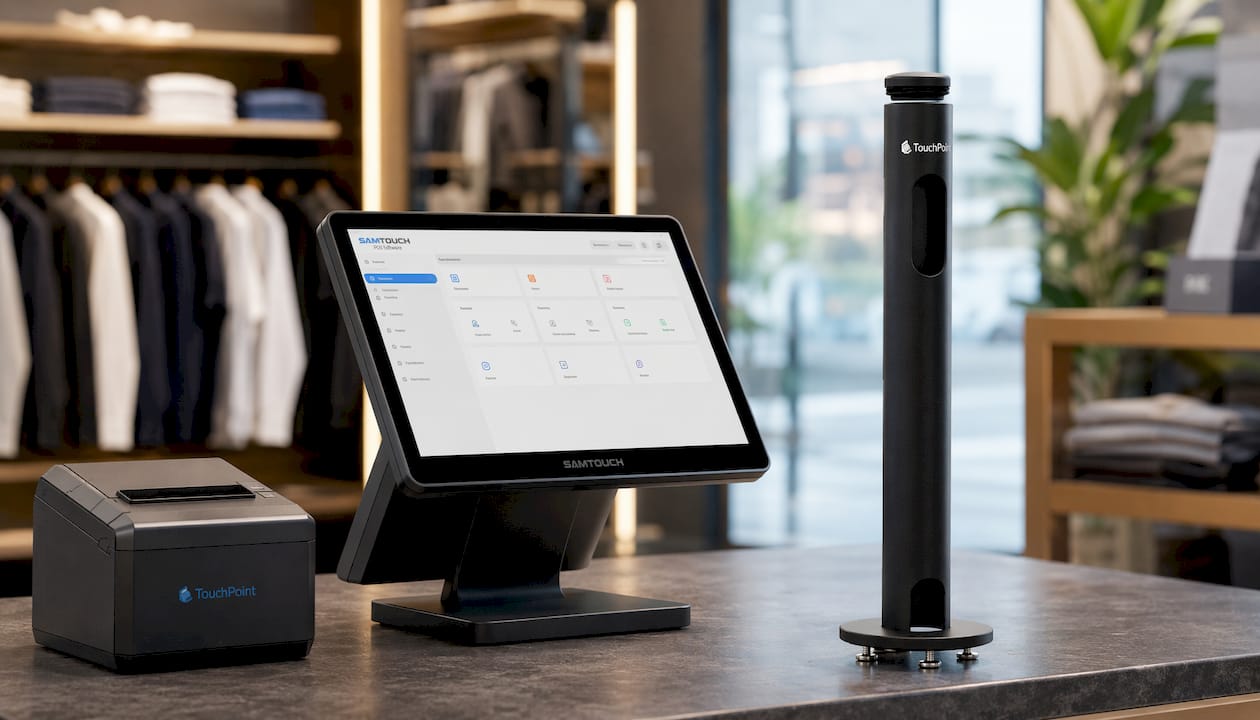
Running a multi-site retail operation without an enterprise POS system is a bit like navigating with a map that is always a day out of date. Ycr has spent over three decades helping UK retailers and hospitality businesses get the right hardware and software in place, from SAMTOUCH POS software with matched hardware for large retail and hospitality environments, to Touchpoint software built specifically for multi-site operational control. If you are evaluating your options, Ycr’s team can help you match the right solution to your network’s actual requirements, with next-day delivery and credit accounts available for business customers.
For a practical starting point on selecting the right system, the POS technology checklist covers the critical factors UK retailers should assess before committing to an enterprise platform.