

TL;DR:
- Modular POS systems allow customization, scalability, and better integration for growing businesses.
- Businesses using modular POS see significant savings, improved inventory turnover, and increased sales.
- Choosing a modular system ensures long-term flexibility and reduces total ownership costs.
Not all point of sale systems are created equal, and the gap between a generic off-the-shelf setup and a truly modular POS solution can mean the difference between stagnation and serious growth. UK retail and hospitality businesses are leaving significant money on the table by treating their POS as a commodity purchase. One UK retail chain with 45 stores used a custom modular approach and achieved £3.2M in annual savings, which should make any business owner stop and reconsider their current setup. This article explains what modular POS actually means, what results you can realistically expect, and how to choose the right configuration for your operation.
Table of Contents
- What is a modular POS solution?
- The efficiency edge: Real-world results from modular POS
- Scaling and customisation: Growing with your business needs
- Integration, flexibility, and total cost: The real long-term advantages
- Our perspective: Why modular is the future for ambitious UK retailers and restaurants
- Explore modular POS solutions and expert guidance
- Frequently asked questions
Key Takeaways
| Point | Details |
|---|---|
| Customise as you grow | Modular POS platforms allow UK businesses to start simple and add features as needs evolve. |
| Proven efficiency | Real-world benchmarks show modular POS can dramatically reduce costs and boost inventory accuracy. |
| Integration flexibility | You can select best-in-class components and integrations, avoiding one-size-fits-all limitations. |
| Lower long-term costs | Targeted modular upgrades reduce unnecessary expenses and lower total cost of ownership. |
| Enhanced customer experience | Modular solutions enable you to quickly adopt innovations that delight customers and optimise service. |
What is a modular POS solution?
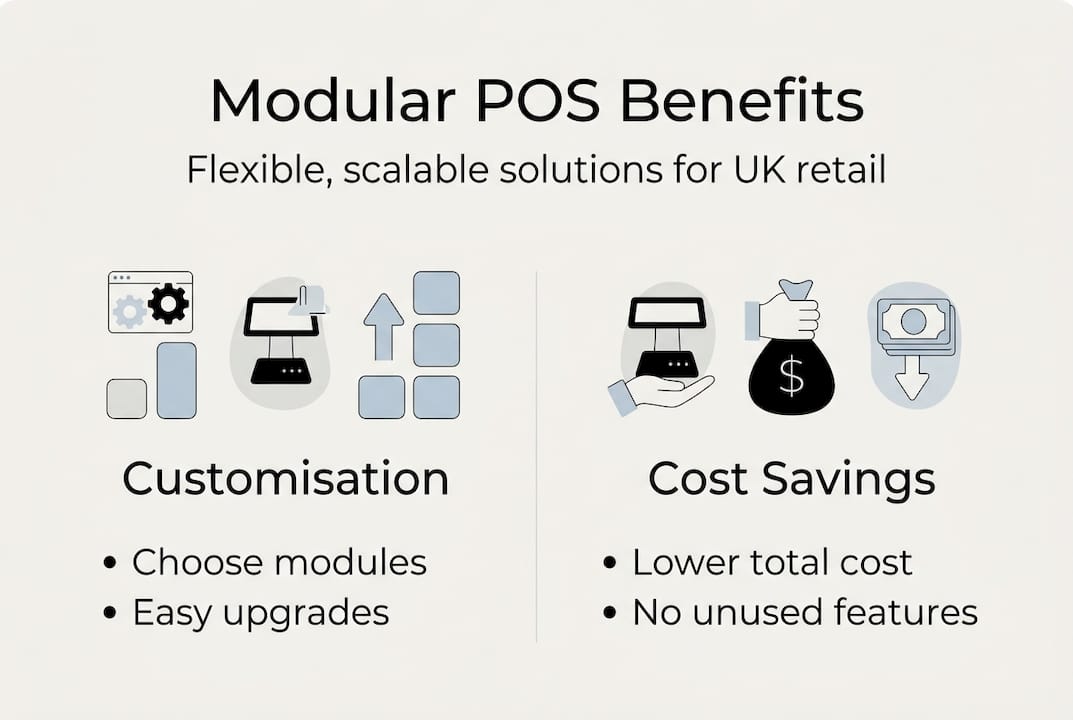
A modular POS system is built around the idea that your business is unique, so your technology should reflect that. Rather than buying a fixed bundle of features you may never use, a modular system lets you select only the components you need. Each component is a “module”, a self-contained feature such as inventory management, loyalty programmes, staff scheduling, or payment processing, that plugs into a central platform.
This is fundamentally different from traditional all-in-one systems, which force you to accept a pre-packaged set of tools. If you run a small café, you probably do not need a complex multi-warehouse stock module. If you operate a multi-site retail chain, you absolutely need real-time stock synchronisation across locations. Modular POS gives you that choice.
Here is a quick comparison to make the difference concrete:
| Feature | Traditional all-in-one POS | Modular POS |
|---|---|---|
| Feature selection | Fixed bundle | Choose what you need |
| Scalability | Limited | Add modules as you grow |
| Integration flexibility | Restricted | Open API, third-party apps |
| Upfront cost | Often high | Pay for what you use |
| Disruption when upgrading | High | Low, modular updates |
Systems like modern POS systems have moved well beyond the cash register era. A modular approach typically includes some or all of the following core capabilities:
- Inventory tracking and stock alerts
- Customer loyalty and rewards
- Payment integration (card, contactless, mobile)
- Reporting and analytics dashboards
- Staff management and clock-in tools
- Online ordering and multichannel sync
The key advantage is flexibility. As your business grows or pivots, you add or remove modules without replacing your entire system. Integrated POS systems built on modular architecture also allow third-party apps to connect cleanly, which is something rigid legacy systems simply cannot offer. Systems like Epos Now demonstrate this well, offering an app store approach with robust inventory management and numerous integrations suited to both retail and hospitality environments.
The efficiency edge: Real-world results from modular POS
With a clear understanding of modular architecture, let us look at the measurable difference it makes for UK businesses. The numbers are, frankly, striking.
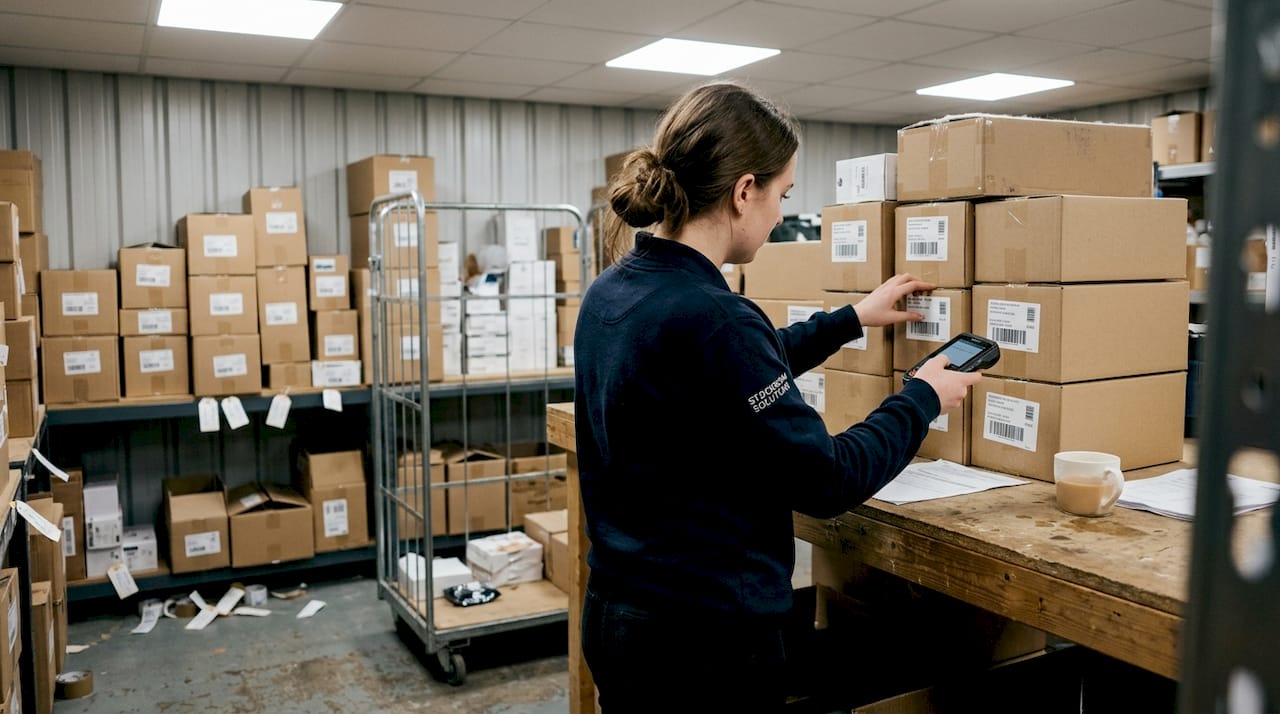
A UK retail chain operating 45 stores adopted a custom modular software solution and recorded a 29% reduction in stock shrinkage alongside a 35% improvement in inventory turnover. The total annual saving reached £3.2M, outperforming every generic POS alternative they had previously trialled. These are not marginal gains. They are business-transforming results.
The financial case extends further. Empirical benchmarks show that modular approaches can yield a 420% ROI in the first year for custom inventory implementations, and a 135% sales increase was recorded for modular mobile POS at Dunelm. Consider what that means for your own operation.
| Metric | Result with modular POS |
|---|---|
| Stock shrinkage reduction | 29% |
| Inventory turnover improvement | 35% |
| Annual savings (45-store chain) | £3.2M |
| First-year ROI (custom inventory) | 420% |
| Sales increase at Dunelm (mPOS) | 135% |
These results do not happen by accident. They happen because modular POS allows businesses to target specific pain points, whether that is stock visibility, queue management, or loyalty redemption, rather than applying a one-size-fits-all fix that addresses nothing particularly well.
“The right modular configuration does not just improve efficiency. It changes what your team is capable of achieving on a daily basis.”
For businesses focused on streamlining retail operations, the modular model allows you to measure the impact of each new feature independently. You know exactly which module is driving which result, making it far easier to justify further investment.
Pro Tip: Before installing any new module, define one measurable KPI it should improve, such as average transaction time or stock accuracy. Review it after 60 days to confirm the return before committing to further additions.
Scaling and customisation: Growing with your business needs
Once efficiency benefits are established, the next advantage is long-term adaptability and controlled growth. This is where modular POS genuinely separates itself from the competition.
The beauty of modular architecture is that it meets you where you are today and grows with you tomorrow. Here is how that progression typically works in practice:
- Start with core functions. Launch with payment processing, basic inventory, and sales reporting. Keep it simple while you establish your baseline.
- Identify your first bottleneck. After a few months, you will clearly see where your operation is losing time or money. Add the module that addresses that specific issue.
- Expand to loyalty and CRM. Once your transactional flow is stable, layer in customer loyalty tools to build repeat business.
- Add multichannel capability. Connect your in-store POS to your online shop or delivery platform without rebuilding your system from scratch.
- Scale across sites. Roll out the same configuration to new locations with real-time stock sync and centralised reporting already in place.
This is exactly the approach taken by Sue Ryder, which operates 420 UK shops and uses unified modular retail software to drive efficiency across its entire estate. Gieves and Hawkes, the heritage menswear brand, adopted the same modular platform for proactive management across its locations, eliminating the integration complexity that had previously slowed decision-making.
For restaurant and hospitality operators, Square’s modular platform allows businesses to begin with basic functionality and scale up with add-ons such as kitchen display systems and handheld POS units, directly improving table turnover and order accuracy.
The role of POS in retail has evolved from simple transaction processing to full operational management, and modular systems are what make that evolution manageable. For hospitality operators exploring options, reviewing top restaurant POS choices can help clarify which modules matter most for your specific service model.
Pro Tip: When phasing in new modules, schedule rollouts during your quietest trading period. Brief your team in advance and run the new module in parallel with existing processes for at least one week before going fully live.
Integration, flexibility, and total cost: The real long-term advantages
Beyond visible benefits, the strength of modular POS lies in its technical flexibility and cost efficiency. This is where many business owners are surprised, because the long-term economics of modular POS are considerably more favourable than they first appear.
Modular POS mechanics involve user-defined integrations and component selection, enabling methodologies such as real-time multi-store synchronisation and targeted add-ons. This directly reduces the long-term total cost of ownership (TCO) for scaling UK firms. TCO refers to the full cost of owning and running a system over time, not just the purchase price.
Off-the-shelf systems often look cheaper upfront but carry hidden costs: expensive vendor lock-in, costly upgrades, and painful workarounds when your business outgrows the system. Modular POS avoids most of these traps.
Common integrations available to UK retail and hospitality businesses include:
- Accounting software such as Xero and Sage
- E-commerce platforms including Shopify and WooCommerce
- Delivery aggregators like Deliveroo and Uber Eats
- Staff scheduling tools
- Customer relationship management (CRM) platforms
- HMRC-compliant VAT reporting tools
These connections are not bolted on awkwardly. In a well-designed modular system, they sync in real time, meaning your stock levels, sales data, and customer records are always current across every channel.
The cost reality: Businesses that switch from rigid all-in-one systems to modular POS consistently report lower ongoing maintenance costs, fewer integration failures, and reduced reliance on expensive IT support. Following POS best practices from the outset, including choosing a platform with open APIs and clear upgrade pathways, protects your investment for years ahead.
The flexibility to add only what you need, when you need it, also means your capital is not tied up in features gathering dust. That is a genuine competitive advantage, particularly for independent retailers and growing hospitality groups watching every pound.
Our perspective: Why modular is the future for ambitious UK retailers and restaurants
Here is something the industry rarely says plainly: most POS frustrations, integration failures, runaway costs, systems that cannot keep up with growth, trace back to a single root cause. The original system was not modular.
We have seen businesses spend more trying to patch a rigid system than it would have cost to build a modular one from the start. The misconception is that modular means complex or expensive. In reality, it means choosing a foundation that does not punish you for growing.
The uncomfortable truth is that many business owners choose their POS based on today’s needs and ignore tomorrow’s entirely. A system that works perfectly for a single-site café becomes a liability the moment you open a second location or launch online ordering.
Thinking about success with POS in 2026 means choosing a platform that accommodates your ambition, not just your current footprint. The businesses winning in UK retail and hospitality right now are not the ones with the cheapest systems. They are the ones with the most adaptable ones.
Explore modular POS solutions and expert guidance
If the results and examples in this article resonate with where your business is heading, the logical next step is to explore what a modular setup could look like for your specific operation.
At YCR Distribution, we have spent over three decades helping UK retail and hospitality businesses find the right combination of hardware and software. Whether you are starting fresh or upgrading an existing setup, our range of POS software solutions and POS hardware options covers everything from standalone terminals to fully integrated multi-site configurations. Get in touch with our team for a tailored consultation, and let us help you build a system that grows with your ambitions rather than holding them back.
Frequently asked questions
What does a modular POS system mean?
A modular POS system lets you choose which features or components to include, allowing customisation and scalability as your business changes. Systems like Epos Now demonstrate this with an app store model that supports both retail and hospitality environments.
Is modular POS right for small businesses?
Yes, because you can start with core features and add modules as you grow, keeping costs and complexity manageable. Platforms like LS Retail allow businesses to start with essentials and expand without integration headaches.
How can modular POS help reduce costs?
Modular POS reduces costs by enabling tailored solutions, minimising unnecessary features, and lowering long-term total cost of ownership. User-defined integrations and targeted add-ons mean you pay for what you actually use.
What are the most common modules in retail and hospitality POS?
Common modules include inventory management, reporting, loyalty programmes, payments, staff management, and online ordering integrations. Epos Now’s app store approach illustrates how these can be selected and combined flexibly.
Can modular POS improve customer experience?
Yes, because you can add features such as loyalty rewards, faster payment options, and seamless multichannel integration precisely when your business is ready for them. Square’s modular add-ons such as kitchen displays and handheld units directly improve service speed and accuracy.