
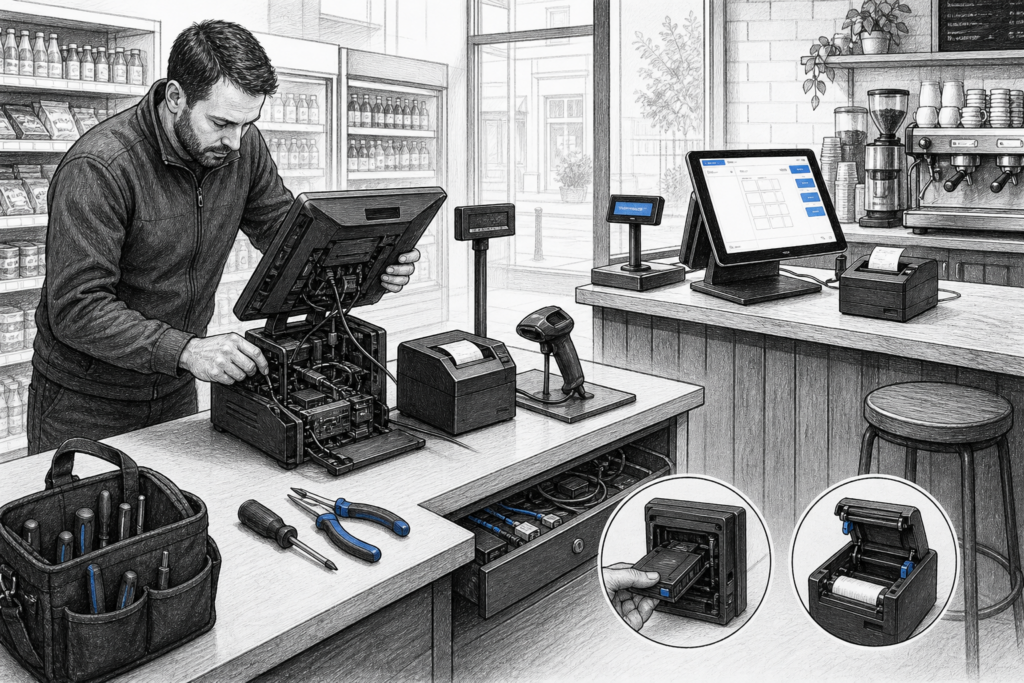
When a checkout or till point fails, the problem is rarely just the device itself. It can slow queues, interrupt service, frustrate staff and create extra pressure on a busy trading day. That is why serviceable POS hardware matters so much in UK retail and hospitality: the easier a system is to maintain, repair and support, the less disruption it creates when something needs attention.
For many businesses, the conversation used to focus only on performance or appearance. Today, resellers, installers and business owners are increasingly looking at the full life of the equipment. Can it be supported easily? Are replacement parts available? Will the system be straightforward to upgrade or refresh later? These questions matter just as much as the initial hardware choice.
What serviceable POS hardware actually means
Serviceable hardware is equipment designed with maintenance in mind. In practical terms, that may mean the unit can be opened, inspected, cleaned or repaired without replacing the entire device. It may also mean that key components can be sourced separately, allowing an installer or service company to restore a system rather than remove it completely.
In point of sale environments, this is especially important because many installations are used for long periods every day. A restaurant till, for example, may be relied on from breakfast through to late evening. A convenience store checkout may be used by multiple staff across different shifts. In both cases, a fault does not just delay a transaction; it interrupts the business itself.
Why repairability matters to UK operators
Replacing a full POS terminal or printer every time a minor fault appears is rarely the most practical option. For retailers and hospitality businesses, repairable equipment can offer several operational advantages:
- less downtime at the checkout or service counter
- lower disruption for staff during busy periods
- simpler maintenance for support teams and EPOS installers
- better use of existing installations and cabling
- more controlled replacement planning for multi-site operators
This is one reason many EPOS professionals prefer commercial hardware over consumer-grade alternatives. POS terminals, printers and related peripherals are built for business use, but the best units are also designed with real-world maintenance in mind. That can make a major difference when a site needs help quickly.
Where serviceability makes the biggest difference
Some parts of a POS installation are more likely than others to need attention over time. Receipt printers, for example, are subject to constant paper handling and regular opening and closing. Thermal print heads, cutters and internal mechanisms all work hard in busy settings. If a printer is designed with servicing in mind, it can often be maintained more efficiently than a unit that is treated as disposable equipment.
POS terminals also benefit from sensible design. In retail and hospitality, equipment may need cleaning, inspection or component-level attention as part of routine support. A terminal that is easy to access and integrate into an existing counter setup is usually simpler to keep in service. That matters whether the site is a small café, a quick-service takeaway, a pub or a multi-branch retail chain.
Useful examples in practice
A farm shop with a small front counter may prefer hardware that can be supported locally without replacing the whole checkout. A busy restaurant may want a printer arrangement that can be maintained quickly if order routing is interrupted. A reseller supporting several independent retailers may value equipment that can be standardised across installations, making spare parts, diagnostics and field support more straightforward.
In each case, serviceability is about reducing friction. If the person supporting the site can identify and address the issue faster, the business gets back to trading sooner.
Why this matters for EPOS resellers and installers
For EPOS dealers and installers, serviceable hardware helps create a more supportable customer base. A system that is easier to maintain can be less stressful to manage over time, particularly where several sites use the same hardware platform. It may also improve customer confidence, because business owners want reassurance that their investment will remain supportable after installation.
That is especially relevant when planning hardware standards for a group of sites. Using a consistent family of terminals or printers can simplify training, support paperwork and spare part planning. It can also help when a replacement is needed quickly and the installer wants to minimise the amount of reconfiguration required.
Choosing hardware with the future in mind
When specifying POS hardware, it is worth looking beyond the initial installation. Consider how the equipment will be maintained in six months, two years or longer. Ask whether replacement components are available, whether the product is practical to support on-site, and whether the system can fit into a longer-term hardware strategy rather than a short-term purchase.
This approach is particularly valuable for businesses replacing older tills or moving from basic cash register style equipment to a more modern EPOS setup. A well-planned migration should not only improve day-to-day operation, but also make future support easier. That means thinking about cable management, peripheral compatibility, printer access and the ease of replacing worn parts.
Why UK support still matters
Access to UK-based product knowledge and distribution support can make the difference between a quick fix and a prolonged outage. When a reseller or business can speak to a supplier that understands the point of sale market, it is often easier to choose the right hardware, identify sensible replacement options and plan support around the realities of retail and hospitality trading.
YCR Distribution works with resellers, installers and businesses across the UK, supplying POS and EPOS hardware, software and related technology. If you are planning a new install, maintaining an existing site or looking for supportable hardware for a multi-site deployment, it is worth considering not only what the equipment does today, but how it will be supported tomorrow.
For more information about point-of-sale hardware and EPOS solutions, contact YCR Distribution on 01924 438238 or visit www.ycr.co.uk.
For resellers and operators, the most practical POS choices are often the ones that are easiest to live with over time. Serviceable hardware can reduce disruption, support better planning and help keep busy counters moving when it matters most.