
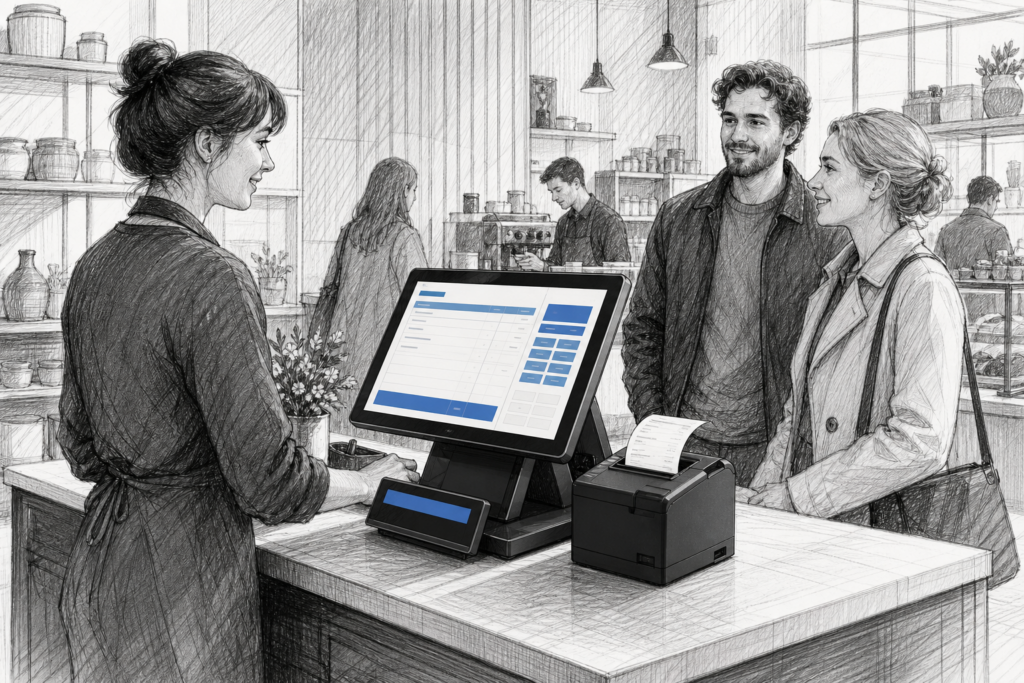
For many UK retailers, cafés, restaurants and multi-site operators, the point of sale has become too important to rely on general-purpose technology. A basic desktop PC or consumer tablet may work for a while, but busy trading environments place very different demands on checkout hardware. Purpose-built POS hardware is designed to cope with those demands far better, which is why so many businesses are rethinking how they equip the till point.
The change is not just about appearance. Modern POS systems UK businesses install need to support fast transactions, repeatable workflows, clear customer interaction and straightforward maintenance. For EPOS resellers and installers, that means recommending hardware that is commercially sensible over the long term, not just something that works on day one.
Why purpose-built hardware matters at the checkout
A point-of-sale terminal is not an office computer moved onto a counter. It is part of a working business environment, often running for long trading days in a space where spills, hurried handling and constant interaction are normal. In retail EPOS and hospitality EPOS settings, the hardware has to support not only the software but also the pace of service.
Purpose-built POS equipment is typically chosen because it can be positioned neatly, connected to essential peripherals and integrated into a more controlled installation. That matters in a busy shop, a café weekend rush or a bar where staff need to process orders and payments without delay. A well-chosen POS terminal can help reduce clutter, improve staff workflow and make the counter easier to manage.
Serviceability is becoming a bigger buying factor
One of the strongest reasons businesses are moving away from generic devices is serviceability. When hardware is used heavily every day, the ability to maintain or replace individual components can make a real difference to uptime. In many cases, retailers and hospitality operators want hardware that an EPOS installer or support partner can work on efficiently, rather than equipment that has to be replaced wholesale at the first sign of trouble.
That is particularly relevant for businesses with several sites or a planned hardware refresh cycle. Standardising on a manageable range of terminals, receipt printers and peripherals can make support easier, reduce training effort and simplify spares planning. For resellers, it also means fewer surprises when a customer needs a replacement unit or a compatible peripheral.
Retail and hospitality have different practical needs
Although both sectors use POS technology, the day-to-day demands are not the same. A convenience store may need barcode scanning, quick item lookup and a compact checkout footprint. A restaurant or pub may prioritise table-side order entry, clear order routing and dependable kitchen and receipt printing. The right hardware choice should reflect those operational differences.
Retail environments
- Fast customer throughput at peak times
- Clear presentation on the counter
- Easy connection to scanners, printers and displays
- Support for stock-driven or item-led workflows
Hospitality environments
- Order capture under pressure
- Reliable front-of-house and back-of-house communication
- Space-saving layouts for compact counters
- Hardware that staff can learn quickly and use confidently
In both cases, the aim is the same: build a point of sale UK businesses can rely on every day without unnecessary disruption.
Why installers and resellers prefer commercial POS ecosystems
EPOS professionals often look beyond the terminal itself. They need to consider how the full system will work together, including receipt printers, customer-facing displays, cash drawers and any specialist peripherals already in place. A good POS installation is not about individual products in isolation; it is about a stable combination that supports the business process.
That is where commercial POS hardware can offer an advantage. It is usually designed with installation in mind, with practical connectivity choices and layouts that suit real-world checkout environments. For a reseller, that makes it easier to propose a complete solution. For the end-user, it means fewer compromises when the system is put into daily use.
YCR Distribution works with UK EPOS resellers, dealers, installers and business owners who need hardware that fits the requirements of a specific site rather than a generic setup. That support is especially useful when planning a new installation or replacing older equipment that is no longer practical to maintain.
Planning for growth instead of just replacing hardware
Many businesses only begin looking at POS hardware when something breaks. In practice, the better approach is to plan ahead. A poorly chosen device can create repeated support calls, awkward workstation layouts and avoidable downtime. A more suitable system can support the business for longer and make future expansion easier.
This is especially important for businesses that are growing, taking on more transactions, opening new locations or changing trading style. A checkout built around purpose-designed EPOS hardware offers a clearer path for standardisation. That can help whether the business is a single independent shop or a multi-site hospitality group.
For owners, the benefits are practical rather than theoretical: faster service, fewer interruptions and a more professional customer experience. For installers and support teams, the benefit is hardware that fits normal service processes more cleanly.
Choosing hardware that suits the real environment
There is no single POS setup that suits every business. The right choice depends on counters, staff workflow, software requirements and the peripherals already in use. But the direction of travel is clear: UK businesses want POS systems UK teams can support properly, not just devices that happen to run the software.
Whether the focus is retail checkout efficiency or hospitality order handling, purpose-built POS hardware is increasingly the more sensible long-term option. It supports better installation planning, easier servicing and a more consistent experience for staff and customers alike.
For more information about point-of-sale hardware and EPOS solutions, contact YCR Distribution on 01924 438238 or visit www.ycr.co.uk.