- +44 1924 438238
- sales@ycr.co.uk
- Mon - Fri: 8:30 - 16:30

Why Upgrade Your POS System – Boosting Restaurant Success
Running a restaurant in the United Kingdom means managing orders, stock, and staff while keeping customers happy—no easy task when competition is sharper than ever. Outdated tills hold you back, but modern POS systems now act as full business platforms, offering real-time inventory control and customer loyalty integration designed to tackle daily pressures head-on. This guide highlights the real advantages of advanced POS technology and shows you how the right system could transform your operation from the kitchen to the front of house.
Table of Contents
- What Modern POS Systems Offer Today
- How Upgrading Transforms Restaurant Operations
- Essential New Features for Restaurants
- Costs, Risks, and Return on Investment
- Choosing the Right System for Your Needs
Key Takeaways
| Point | Details |
|---|---|
| Modern POS Systems Enhance Efficiency | Today’s POS systems streamline operations with real-time reporting, automated inventory management, and integrated customer loyalty programmes, significantly improving profitability. |
| Integration Is Crucial | A successful POS system must connect seamlessly with existing tools and platforms to eliminate manual data entry and enhance operational efficiency. |
| Data-Driven Decision Making | Upgrading to modern systems allows restaurants to make informed decisions based on real-time data analytics, optimising menu offerings and staffing needs. |
| Prioritise Customer Experience | Features such as mobile payment and personalised service create smoother interactions, enhancing customer satisfaction and loyalty significantly. |
What Modern POS Systems Offer Today
Modern POS systems have evolved far beyond simple till registers. They’re now comprehensive platforms that handle multiple aspects of your restaurant operation simultaneously. Whether you run a casual café or a fine dining establishment, today’s systems offer capabilities that directly impact your bottom line.
Core Features That Drive Results
Today’s POS technology delivers faster checkout experiences alongside real-time inventory management and customer analytics. These aren’t optional extras—they’re fundamental to how modern restaurants compete.
Here’s what you actually get:
- Automated inventory tracking that alerts you when stock runs low, preventing costly stockouts during service
- Customer data analytics showing which dishes sell best, peak hours, and individual customer preferences
- Integrated loyalty programmes that encourage repeat visits without manual paperwork
- Employee performance monitoring so you understand who’s driving sales and where training helps
- Omnichannel capabilities including online ordering, delivery integration, and table reservations in one system
Each feature solves a real problem you face daily.
Real-Time Operations, Not Delayed Reports
Older systems gave you data hours or days later. Modern POS systems show what’s happening right now. Your kitchen screen updates instantly when orders arrive. Your manager can check cash flow at any moment from their phone. Stock levels update as items sell, not at end of day.
Real-time visibility transforms how you manage your restaurant—you react to what’s actually happening, not what happened yesterday.
This matters enormously. If a dish isn’t selling, you spot it within hours, not weeks. If a staff member is underperforming, you see the pattern immediately.
Integration With Your Other Systems
Your POS shouldn’t exist in isolation. Modern systems connect with suppliers, accounting software, and booking platforms. This removes manual data entry and the errors that come with it. Orders sync automatically with your accountant. Reservations feed into table management. Delivery platforms pull your menu directly.
Scalability That Grows With You
Planning to open a second location? Modern POS systems handle multi-site operations effortlessly. You see consolidated reporting across all venues. Inventory flows between locations if needed. Staff can work at either site with the same login. There’s no painful migration when you expand.
Customer Experience Improvements
Your customers notice better service when your team has the right tools. Faster checkouts mean shorter queues. Personalised recommendations based on their history make them feel valued. Loyalty rewards feel less like corporate nonsense and more like genuine appreciation.

A customer who visits weekly shouldn’t feel like a stranger on their tenth visit. Modern POS systems ensure your team recognises them, remembers their preferences, and makes their experience seamless.
Pro tip: When evaluating modern POS systems, prioritise ones that offer genuine integration with your existing suppliers and accounting software—this saves hours of manual data entry each week.
How Upgrading Transforms Restaurant Operations
Upgrading your POS system doesn’t just mean faster checkouts. It fundamentally changes how your entire restaurant runs. From the moment a customer walks in until they pay and leave, every step becomes smoother, more efficient, and more profitable.
Streamlined Transaction Processing
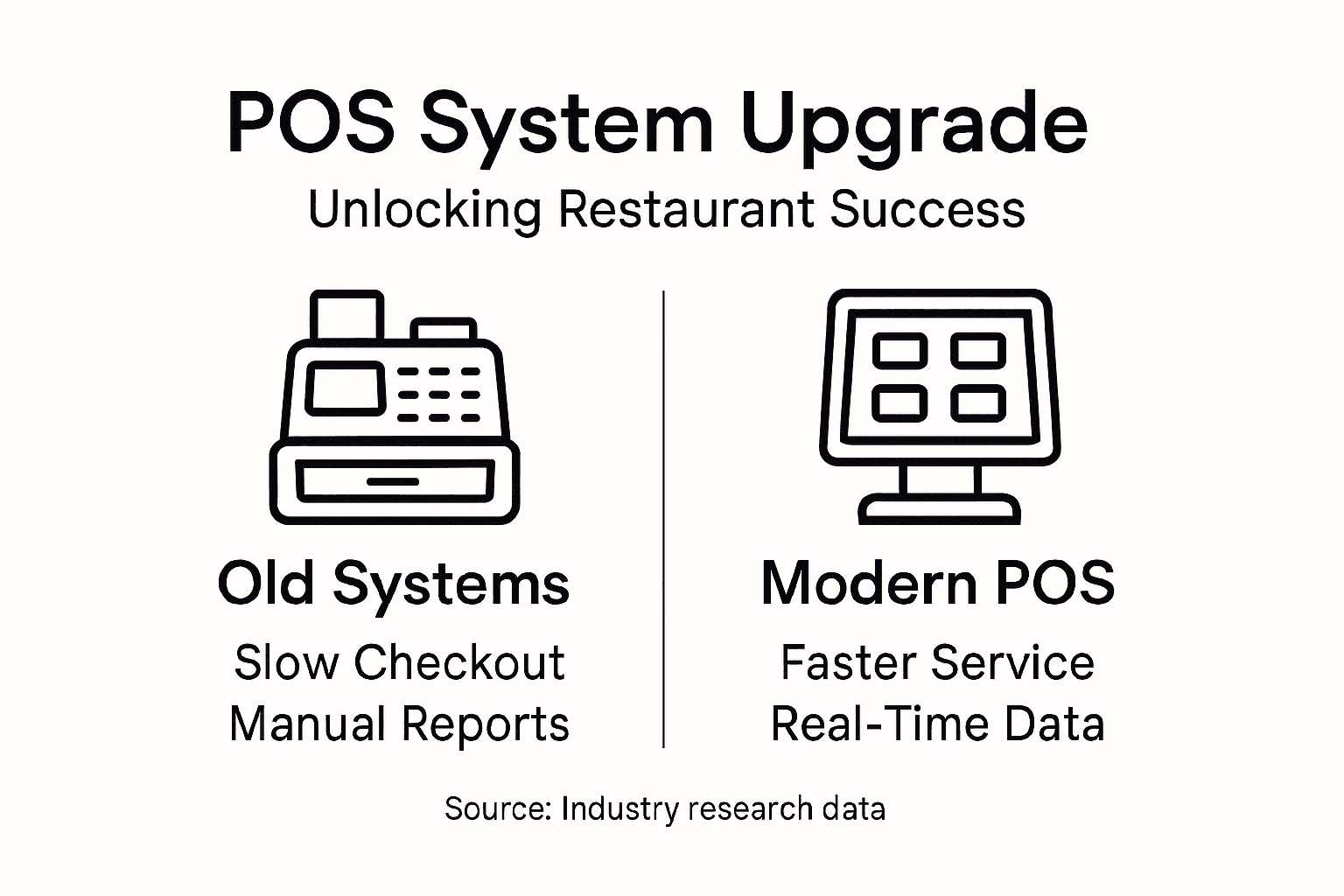
Old POS systems slow down service. Staff fumble with menus, prices change, nothing syncs properly. Modern upgrades eliminate these friction points entirely. Your team processes transactions faster, errors drop dramatically, and customers experience noticeably quicker service.
When customers spend less time waiting to pay, they leave happier. They’re also more likely to return and recommend you to others.
To better understand how POS upgrade impacts a restaurant, see how modern and legacy systems compare:
| Area | Legacy POS Systems | Modern POS Systems |
|---|---|---|
| Data Access | End-of-day reports | Real-time alerts and dashboards |
| Inventory Control | Manual counts, delayed | Automatic, predictive, live tracking |
| Customer Loyalty | Paper punch cards | Integrated, digital, personalised rewards |
| Payment Options | Cash and chip cards only | Contactless, mobile, QR, card, online |
| Integration | Standalone, manual syncing | Automated links to kitchen, suppliers, accounts |
| Expansion Support | Often requires full migration | Effortless multi-site handling |
| Decision Making | Based on gut feel | Data-driven, actionable insights |
Real Inventory Control That Actually Works
Inventory management is where most restaurants bleed money invisibly. You order too much of something that sits unused. You run out of something popular mid-service. You can’t track waste or spoilage accurately.
Upgrading to modern POS systems optimises inventory levels automatically. The system tracks what sells, predicts what you’ll need, and alerts you before stock runs critically low. Waste drops significantly because you see exactly what’s moving and what’s gathering dust.
Key inventory benefits include:
- Real-time stock visibility across your entire operation
- Automated reorder alerts based on actual sales patterns
- Reduced waste through precise usage tracking
- Better supplier negotiations using accurate demand data
- Prevention of costly stockouts during peak service
Decision-Making Based on Real Data
Before upgrades, managers make decisions on gut feeling. “This dish probably sells well.” “Staffing feels about right.” Without concrete data, you guess wrong. Expensive guesses.
Modern systems provide detailed operational insights instantly. You see exactly which dishes drive profit, which hours need more staff, which promotions actually work. This transforms how you operate.
Real data changes everything. You stop relying on assumptions and start responding to what customers actually want.
You can now make informed decisions about menu changes, pricing adjustments, and staffing levels. Every decision comes backed by actual numbers, not hunches.
Unified Operations Across Everything
Without integration, your POS, kitchen display, inventory system, and delivery platform all exist in separate universes. Information gets lost between systems. Staff duplicate work. Errors compound.
Upgraded systems unify all operations into one workflow. An order hits the kitchen display instantly. Inventory updates automatically. Delivery platforms see real-time availability. Your accountant gets accurate figures without manual entry.
This integration saves hours weekly and prevents costly mistakes.
Customer Satisfaction Through Speed and Consistency
Faster service means happier customers. Better data means personalised interactions. Loyalty programmes actually reward repeat visits. Your team has time to be attentive because they’re not wrestling with technology.
The result is measurably better customer experience. People notice. They come back. They tell friends.
Pro tip: When upgrading your POS, prioritise systems offering mobile payment capabilities and real-time kitchen displays—these two features alone typically cut average transaction time by 20-30% whilst reducing order errors.
Essential New Features for Restaurants
Not all POS upgrades are equal. Some additions genuinely transform how you operate. Others feel nice but don’t move the needle. Here’s what actually matters for your restaurant’s bottom line.
Payment Flexibility That Customers Expect
Customers want options. Card payments, contactless, mobile wallets, QR codes—they don’t want friction at checkout. Modern systems support mobile and contactless payment methods seamlessly.
This isn’t luxury. It’s baseline expectation. Customers without cash or their preferred payment method skip you entirely. Modern payment support removes that barrier completely.
Real-Time Kitchen Communication
Your kitchen and front-of-house staff shouldn’t communicate via shouted orders or written tickets. That’s how mistakes happen. Food comes out wrong. Orders get forgotten. Customers wait unnecessarily.
Integration with kitchen display systems eliminates this chaos. Orders appear instantly on kitchen screens. Staff see exactly what’s needed and in what sequence. This alone cuts order errors dramatically and speeds service significantly.
Omnichannel Ordering—Meeting Customers Where They Are
Your restaurant isn’t just the physical location anymore. Customers order online, via apps, through delivery platforms, by phone, and in person. Managing these separately is chaos.
Essential features include:
- Online ordering integration connecting directly to your POS
- Delivery platform synchronisation showing real-time availability
- Table reservation management coordinating walk-ins and bookings
- Mobile ordering capability for faster in-restaurant service
- Consistent menu management across all ordering channels
One system managing all channels prevents duplicate orders, inventory mismatches, and customer confusion.
Customer Loyalty That Actually Works
Old loyalty programmes required punch cards and manual tracking. They didn’t work. Modern systems automate this completely. Customers earn points automatically. Rewards apply instantly. Personalised offers appear based on their purchase history.
The result? Customers return more frequently. They spend more per visit. They tell friends about your rewards. Integrated loyalty programmes create genuine repeat business.
Advanced Reporting That Reveals Hidden Patterns
Automated reporting tools show which dishes drive profit, which hours need staffing, and which promotions work. You spot trends instantly rather than wondering why something isn’t performing.
You also track employee performance metrics—who’s closing sales effectively, who needs training, which shifts run smoothest. This data transforms how you staff and train your team.
The restaurants pulling ahead aren’t just faster or cheaper—they’re making decisions based on data nobody else bothers to collect.
Inventory Automation That Prevents Waste
Automatic inventory tracking eliminates guesswork entirely. The system knows exactly what you have, what sells, and what you’ll need. This prevents both costly waste and embarrassing stockouts during service.
Pro tip: When selecting a new POS, prioritise systems offering kitchen display system integration and real-time payment support—these two features typically improve order accuracy by 35% whilst cutting payment processing time by half.
Costs, Risks, and Return on Investment
Upgrading your POS isn’t free. There are real costs, genuine risks, and implementation headaches. But the financial picture becomes clear when you understand what you actually get in return.
What You’ll Actually Spend
Initial costs include hardware (terminals, printers, kitchen displays), software licences, and installation. Expect ongoing expenses for maintenance, updates, and technical support. Staff training takes time and money upfront.
For a small to medium restaurant, hardware typically costs £2,000–£8,000 depending on complexity. Annual software and support fees range from £500–£3,000. Training might require bringing staff in early or hiring temporary cover.
But here’s the critical part: these costs are front-loaded. Most happen in month one. Savings start immediately.
The Risks Worth Understanding
Implementing new POS systems carries real risks including compatibility issues, data security concerns, and staff resistance. Your kitchen might struggle with new workflows. Payment processing could fail during critical moments. Staff might make mistakes until they’re fully trained.
Key risks to prepare for:
- Temporary service disruption during migration
- Staff frustration during learning curve
- Data compatibility if switching from older systems
- Cybersecurity threats requiring strong protocols
- Initial bugs or glitches needing vendor support
These aren’t dealbreakers. They’re challenges to manage carefully with proper planning and vendor support.
When You Actually Break Even
Most restaurants recover their investment within 12–18 months. How? Through measurable savings and revenue increases.
Modern POS systems reduce fraud and errors while enabling data-driven decision-making that increases profitability. Waste drops 10–15% through better inventory control. Labour costs decrease because scheduling becomes efficient. Customer retention improves through loyalty programmes and faster service.
Typical first-year returns include:
Here’s a summary of expected financial impact after upgrading your POS system:
| Benefit Area | Typical Annual Savings | Measurable Outcome |
|---|---|---|
| Waste Reduction | £3,000–£8,000 | Lower food spoilage costs |
| Labour Efficiency | £2,000–£6,000 | Fewer staff hours needed |
| Fraud & Error Prevention | £1,000–£3,000 | Reduced unauthorised losses |
| Customer Retention | £2,000–£5,000 | More repeat visits, higher spend |
| Menu Optimisation | £1,000–£4,000 | Higher profit per dish |
- Waste reduction saving £3,000–£8,000
- Labour efficiency gains worth £2,000–£6,000
- Reduced fraud preventing £1,000–£3,000 loss
- Improved customer retention adding £2,000–£5,000 revenue
- Better menu decisions optimising £1,000–£4,000 in margins
The math works. Most restaurants see positive ROI within 18 months, then enjoy pure profit for years.
Long-Term Financial Impact
After you break even, the benefits compound. You’re not just recovering costs—you’re running a genuinely more profitable operation. Staff schedule better. Customers return more frequently. You waste less food. Decision-making improves continuously.
Over five years, a typical restaurant sees cumulative savings and revenue increases of £20,000–£50,000 from a single POS upgrade.
Risk Mitigation Strategies
Choose vendors offering strong support and training. Implement gradually if possible—maybe one location first. Ensure staff training happens properly before launch. Verify data security certifications. Have a rollback plan if something fails.
Work with vendors who understand hospitality. They anticipate problems and help you navigate them.
Pro tip: Request a detailed cost breakdown from your vendor showing hardware, software, training, and support. Then calculate your realistic payback period based on your current waste and labour costs—most restaurants discover they’ll break even faster than expected.
Choosing the Right System for Your Needs
Not every POS system suits every restaurant. Your café has different needs than a fine dining establishment. Your takeaway operates differently than a gastro-pub. Choosing the wrong system wastes money and creates frustration.
Start With Your Business Goals
Before looking at any system, understand what you’re actually trying to achieve. Do you want faster service? Better inventory control? Improved customer loyalty? Multi-location management? Each goal points toward different features.
Write down your top three priorities. Everything else is secondary. This clarity prevents you from being dazzled by features you don’t need.
Evaluate Integration Capabilities
Your POS shouldn’t exist in isolation. It needs to connect with your suppliers, accountants, delivery platforms, and reservation systems. Selecting a suitable POS system requires evaluating integration capabilities with existing operations and the ability to scale as your business grows.
Before committing, verify the system integrates with:
- Your current accounting software
- Major delivery platforms you use
- Supplier ordering systems
- Booking and reservation tools
- Kitchen display systems you’re considering
- Customer loyalty programme platforms
If critical integrations aren’t available, you’ll be doing manual data entry forever.
Assess Security and Compliance Standards
Payment security isn’t optional. Your customers’ card data must be protected to PCI DSS standards. Data breaches destroy trust and carry legal liability.
Choosing the right POS system requires assessing the vendor’s security features and compliance with payment regulations. Ask vendors directly about their security certifications, encryption standards, and how they handle data backups.
If they can’t clearly explain their security approach, they’re not ready for your business.
Cloud-Based Versus On-Premise
Cloud systems cost less upfront and receive automatic updates. On-premise systems give you more control but require technical maintenance. Most restaurants benefit from cloud-based solutions—they’re more flexible and require no IT expertise.
The right system feels invisible. You and your staff should focus on running the restaurant, not managing technology.
Vendor Support Matters More Than Features
Features are useless if something breaks and nobody helps you fix it. Evaluate vendor support carefully. Can you reach them by phone during service hours? Do they offer training for your team? What’s their response time for critical issues?
Read reviews specifically about customer support. Features are secondary to reliability and help when you need it.
Test Before You Commit
Demand a proper trial period. Not a five-minute demo at their office, but actually using the system with your team. See how it handles your specific workflows. Ask staff what frustrates them. Trial reveals problems demos hide.
Scalability for Future Growth
Choose a system that grows with you. If you plan a second location in two years, your POS should handle multi-site operations seamlessly. If delivery will become important, the system should integrate with delivery platforms easily.
Think five years ahead. Can the system still serve you then?
Pro tip: Request a written list of all integration partners, security certifications, and support response times from any vendor you’re seriously considering—compare these objectively rather than relying on sales pitches.
Unlock Your Restaurant’s Full Potential with a Modern POS Upgrade
The article reveals how outdated POS systems hold restaurants back by slowing service, causing inventory headaches, and limiting valuable data insights. You need a solution that offers real-time operations, seamless integration, and powerful analytics to drive smarter decisions and elevate customer satisfaction. If you want to overcome issues like slow checkouts, wasted stock, and manual errors, investing in a robust POS system is critical.
YCR Distribution specialises in exactly these challenges, offering trusted POS hardware and software tailored for restaurants, cafes, and hospitality businesses across the UK. With solutions like SAMTOUCH and EZEEPOS, you gain faster checkout speeds, automated inventory control, integrated loyalty programmes, and comprehensive multi-channel management. Backed by over 30 years of experience and partnerships with leading brands such as SAM4S and iMin, YCR ensures you get not just technology, but reliable service with next-day delivery and expert support.
Ready to transform your restaurant’s operations and boost profitability? Visit YCR Distribution to explore how their complete POS hardware and software solutions can help you make data-driven decisions, reduce waste, and delight your customers. Don’t wait—upgrade now to reap faster payback, greater efficiency, and ongoing success.
Frequently Asked Questions
What are the main benefits of upgrading to a modern POS system?
Upgrading to a modern POS system can streamline transaction processing, improve inventory management, enhance customer loyalty programmes, and provide real-time data insights, all of which contribute to better efficiency and profitability in your restaurant.
How does a modern POS system improve inventory management?
A modern POS system automates inventory tracking, providing real-time stock visibility and reorder alerts based on actual sales data. This helps reduce waste, prevents costly stockouts, and optimises your inventory levels effectively.
Why is real-time data important for restaurant management?
Real-time data allows restaurant managers to make informed decisions quickly. It enables immediate adjustments to menu offerings, staffing needs, and inventory levels based on current sales, improving overall operational efficiency and customer satisfaction.
What should I consider when choosing a new POS system for my restaurant?
When selecting a new POS system, consider your business goals, integration capabilities with existing operations, security standards, support options from the vendor, and the system’s scalability for future growth.